Randolph County Dog Registration Information
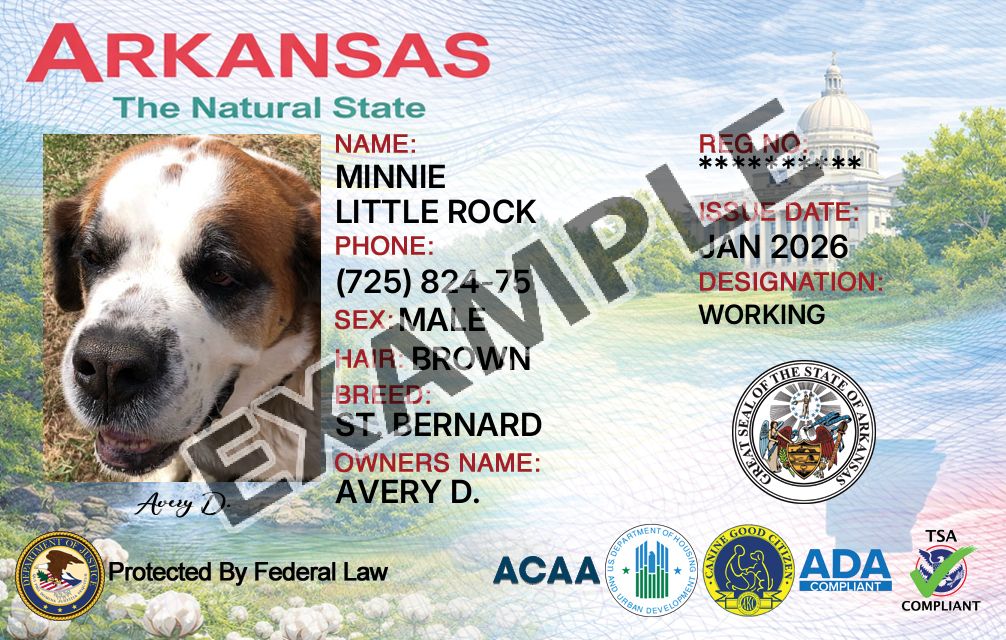
Service Dogs and Emotional Support Animals in Randolph, Arkansas
If you’re searching for where do I register my dog in Randolph County, Arkansas for my service dog or emotional support dog, it helps to separate two different ideas: (1) local dog licensing (often handled by a city animal control office or city clerk for residents inside city limits), and (2) the legal status of a service dog or emotional support animal (ESA), which is not established through any one universal federal registry.
Below is verified contact information for key local offices serving Randolph County residents, plus clear steps and documentation tips to help you comply with local dog licensing requirements in Randolph County, Arkansas while understanding what does (and does not) apply to service dogs and ESAs.
- Dog licensing is typically handled locally (often by a city office if you live inside city limits).
- Service dogs are not “registered” by a single federal program. Their status comes from how they are trained and used under disability laws, not from a registry card.
- Emotional support animals (ESAs) are not service dogs. An ESA is generally supported by documentation for specific housing-related situations, not by a county registration.
- Local rules can vary by municipality within Randolph County, Arkansas, so where you register a dog in Randolph County may depend on your city address.
Where to Register or License Your Dog in Randolph County, Arkansas
The offices below are the most relevant official local agencies for animal control and city-level dog licensing in Randolph County, Arkansas (especially for residents in or near Pocahontas). If you live in another incorporated city or town within Randolph County, your municipality may have its own rules and point of contact for a dog license in Randolph County, Arkansas.
Pocahontas Animal Control (City of Pocahontas)
Pocahontas City Clerk / Treasurer’s Office (City of Pocahontas)
Randolph County Assessor (Randolph County, Arkansas)
Randolph County Sheriff’s Office (Randolph County, Arkansas)
Overview of Dog Licensing in Randolph County, Arkansas
What “dog licensing” usually means locally
When people ask “where to register a dog in Randolph County, Arkansas,” they are usually referring to a local dog license (sometimes called a tag). A dog license is a local compliance record that helps confirm a dog has required vaccinations (commonly rabies) and provides a way to identify owners if a dog is found.
County vs. city rules
In Arkansas, dog control and licensing policies are often enforced at the city level (for residents inside city limits) through an animal control division, police department, or city clerk’s office. In unincorporated areas (outside city limits), county offices may be able to direct you to the correct authority, but the exact process can differ depending on where you live in Randolph County.
How this affects service dogs and ESAs
Even if your dog is a service dog or an emotional support animal, local rabies vaccination and local dog licensing requirements Randolph County, Arkansas (when applicable) may still apply. The key point is that a local dog license is not the same thing as “registering” a service dog or ESA.
What You Need Before Registering a Dog
Common documents and details to prepare
Requirements vary by city and sometimes by the type of license being issued, but most local offices that handle an animal control dog license Randolph County, Arkansas will ask for some combination of the following:
- Proof of current rabies vaccination (rabies certificate from a licensed veterinarian)
- Owner identification (driver’s license or other ID)
- Proof of address/residency (especially if licensing is city-based)
- Dog description (breed, color/markings, age, sex)
- Spay/neuter documentation (if your local fee schedule differs)
- Payment for any licensing/tag fee (method depends on the office)
Service dog and ESA paperwork (what’s relevant)
For local licensing, offices typically focus on vaccination and owner contact information—not service dog “registration papers.” For housing-related ESA situations, documentation typically relates to the housing provider’s requirements and applicable law, rather than a county tag.
Steps to Register or License a Dog in Randolph County, Arkansas
Step 1: Confirm whether your address is inside city limits
The fastest way to get the correct answer to “where do I register my dog in Randolph County, Arkansas” is to confirm whether you live inside a municipality (such as Pocahontas) or in an unincorporated area. City addresses often go through city offices; county offices can help route you if you are outside city limits.
Step 2: Call the most relevant local office first
For many residents, the most direct starting point is a city animal control office (for enforcement and shelter-related processes) or the city clerk’s office (for licensing administration). In Pocahontas, you can start with either:
- Pocahontas Animal Control for animal control ordinances, enforcement, and guidance on how tags or local requirements are handled
- Pocahontas City Clerk / Treasurer’s Office to confirm whether the clerk’s office processes licensing/tag paperwork for city residents
Step 3: Bring or provide proof of rabies vaccination
Many local licensing systems require proof of rabies vaccination. If your dog’s rabies vaccination is not current, schedule it with a licensed veterinarian first so you can present the certificate.
Step 4: Ask about tag/renewal timing and replacement tags
If a physical tag is issued, ask how long it is valid, whether renewals are annual, and what to do if a tag is lost. Also ask if there are different fees for altered vs. unaltered pets, if applicable.
Service Dog Laws in Randolph County, Arkansas
No single federal “service dog registry”
Service dogs are not made “official” through a universal federal registration system. A service dog’s legal status comes from the dog being individually trained to perform tasks for a person with a disability and the handler’s rights under applicable disability laws. A plastic card, certificate, or online listing is not what creates service dog status.
How local dog licensing interacts with service dogs
A local dog license (when required by your city) is a standard pet ownership compliance step. Being a service dog generally does not eliminate basic public health requirements (like rabies vaccination) or neutral licensing requirements that apply to dogs within a city’s jurisdiction.
Service dog vs. pet in public spaces
Service dogs are generally allowed in public places where pets are not, but they still must be under control. If you’re trying to figure out what documentation you need for a service dog, focus on training and lawful behavior expectations rather than “registration.”
Quick comparison: dog license vs. service dog vs. emotional support animal
| Category | Dog License (Local Tag) | Service Dog | Emotional Support Animal (ESA) |
|---|---|---|---|
| What it is | Local licensing record (often city-based) used for identification and compliance | Dog trained to perform specific tasks for a person with a disability | Animal that provides emotional support; not task-trained as a service dog |
| Who issues it | City/municipal office (or local animal services) where you live | No single government registry; status is based on training and legal definition | No single government registry; status is typically supported by housing-related documentation |
| Common documentation | Rabies certificate; owner ID; address information; payment (if required) | No universal “registration papers” required; focus is on trained tasks and control | Documentation may be requested by housing providers (varies by situation); not a county license |
| Main purpose | Public health and identification (rabies compliance, owner traceability) | Disability assistance through trained tasks | Emotional support, primarily relevant to housing contexts |
| Does it replace local licensing? | N/A | Usually no; local licensing rules may still apply based on address | Usually no; local licensing rules may still apply based on address |
Emotional Support Animal Rules in Randolph County, Arkansas
ESAs are not the same as service dogs
An emotional support animal (ESA) is not a service dog. ESAs are not task-trained to perform specific disability-related work in the way service dogs are. Because of that, ESA status does not function like a special local “license” and usually does not grant the same public access expectations as service dogs.
What “registering” an ESA usually means in practice
People often say “register my emotional support dog,” but for most real-world situations this is about having the appropriate documentation for a housing provider’s process (when applicable), not filing something with a county office. If you also need a city dog license in Randolph County, Arkansas, that is a separate step handled by the local licensing office for your address.
Local compliance still matters
Whether your dog is a pet, service dog, or ESA, local animal rules can still apply, including leash/run-at-large rules and vaccination requirements. If you live in Pocahontas, contacting the local animal control office is typically the best way to confirm city-specific requirements.
Frequently Asked Questions
Possibly, depending on where you live. A service dog’s legal status is separate from local licensing. If your municipality requires a local dog license (tag) and proof of rabies vaccination, those requirements may still apply even for a service dog. Call the office that serves your address (for example, Pocahontas Animal Control or the Pocahontas City Clerk if you live in the city).
If you are outside Pocahontas city limits, your licensing or animal control contact may differ. Start by calling a county office (such as the Randolph County Assessor or Randolph County Sheriff’s Office) and ask which local authority handles dog licensing or animal services for your specific address in Randolph County.
- Rabies vaccination certificate (commonly required)
- Owner identification
- Proof of address (especially for city licensing)
- Spay/neuter documentation (if your city has different fees)
- Payment for the license/tag fee (method varies by office)
No. Service dogs and emotional support animals are not established through a single universal federal registry. Local dog licensing (if required) is separate from service dog or ESA status.
If you’re in Pocahontas, start with Pocahontas Animal Control for ordinance and enforcement questions, and the Pocahontas City Clerk / Treasurer’s Office for administrative/licensing questions. If you’re unsure, call one office and ask to be directed to the correct place for dog licensing requirements in Randolph County, Arkansas based on your address.
Local note for Randolph County residents
If an office cannot confirm your licensing authority right away, ask these two questions: (1) “Does my address fall inside city limits?” and (2) “Which office issues dog license tags and keeps the dog licensing records for my address?” That will usually resolve confusion quickly.
What You May Need
-
CommonProof of rabies vaccinationRabies certificate from a licensed veterinarian
-
VariesProof of residencyUtility bill, lease, or other local address proof (if requested)
-
CommonIdentificationDriver’s license or state ID
-
VariesSpay/neuter documentation (if applicable)May affect eligibility or fee schedules in some areas
-
CommonPayment for licensing feeAsk office which payment methods are accepted
Register A Dog In Other Arkansas Counties
Select your county below to get started with your dog’s ID card. Requirements and license designs may vary by county, so choose your location to see the correct options and complete your pup’s registration.
- Arkansas County Dog Registration
- Ashley County Dog Registration
- Baxter County Dog Registration
- Benton County Dog Registration
- Boone County Dog Registration
- Bradley County Dog Registration
- Calhoun County Dog Registration
- Carroll County Dog Registration
- Chicot County Dog Registration
- Clark County Dog Registration
- Clay County Dog Registration
- Cleburne County Dog Registration
- Cleveland County Dog Registration
- Columbia County Dog Registration
- Conway County Dog Registration
- Craighead County Dog Registration
- Crawford County Dog Registration
- Crittenden County Dog Registration
- Cross County Dog Registration
- Dallas County Dog Registration
- Desha County Dog Registration
- Drew County Dog Registration
- Faulkner County Dog Registration
- Franklin County Dog Registration
- Fulton County Dog Registration
- Garland County Dog Registration
- Grant County Dog Registration
- Greene County Dog Registration
- Hempstead County Dog Registration
- Hot Spring County Dog Registration
- Howard County Dog Registration
- Independence County Dog Registration
- Izard County Dog Registration
- Jackson County Dog Registration
- Jefferson County Dog Registration
- Johnson County Dog Registration
- Lafayette County Dog Registration
- Lawrence County Dog Registration
- Lee County Dog Registration
- Lincoln County Dog Registration
- Little River County Dog Registration
- Logan County Dog Registration
- Lonoke County Dog Registration
- Madison County Dog Registration
- Marion County Dog Registration
- Miller County Dog Registration
- Mississippi County Dog Registration
- Monroe County Dog Registration
- Montgomery County Dog Registration
- Nevada County Dog Registration
- Newton County Dog Registration
- Ouachita County Dog Registration
- Perry County Dog Registration
- Phillips County Dog Registration
- Pike County Dog Registration
- Poinsett County Dog Registration
- Polk County Dog Registration
- Pope County Dog Registration
- Prairie County Dog Registration
- Pulaski County Dog Registration
- Saline County Dog Registration
- Scott County Dog Registration
- Searcy County Dog Registration
- Sebastian County Dog Registration
- Sevier County Dog Registration
- Sharp County Dog Registration
- St. Francis County Dog Registration
- Stone County Dog Registration
- Union County Dog Registration
- Van Buren County Dog Registration
- Washington County Dog Registration
- White County Dog Registration
- Woodruff County Dog Registration
- Yell County Dog Registration